
After three decades fortifying brands, I’ve learned one thing that shows up every time:
The domain name decision reveals more about a company’s ambition than any pitch deck ever could.
Most marketing leaders treat domain acquisition like a procurement exercise. They see a price, compare it to quarterly ad spend, and decide the premium option is too expensive. Then they move forward with something forgettable, convinced they’ll make up for it with better marketing.
That logic feels reasonable in the moment, but it rarely holds up over time.
The invisible erosion no one tracks
Here’s what actually happens next.
The company launches with a modified domain. A “try” prefix. A .io extension. An extra word that made sense at the time.
The product gains traction. The team executes. Growth starts to show. And then something subtle begins to happen.
Prospects type the wrong URL and land on a competitor. Referrals break because no one remembers the full name. Investor meetings include a moment of explanation about why the domain is what it is. Sales calls start with spelling the URL.
None of this shows up in your dashboard. But it compounds.
These aren’t catastrophic failures. They’re small, repeated friction points that quietly tax every interaction your brand has with the market.
Over time, that “saved” cost becomes one of the most expensive decisions you made.
I’ve never seen a company regret buying the right domain. I’ve seen plenty regret settling.
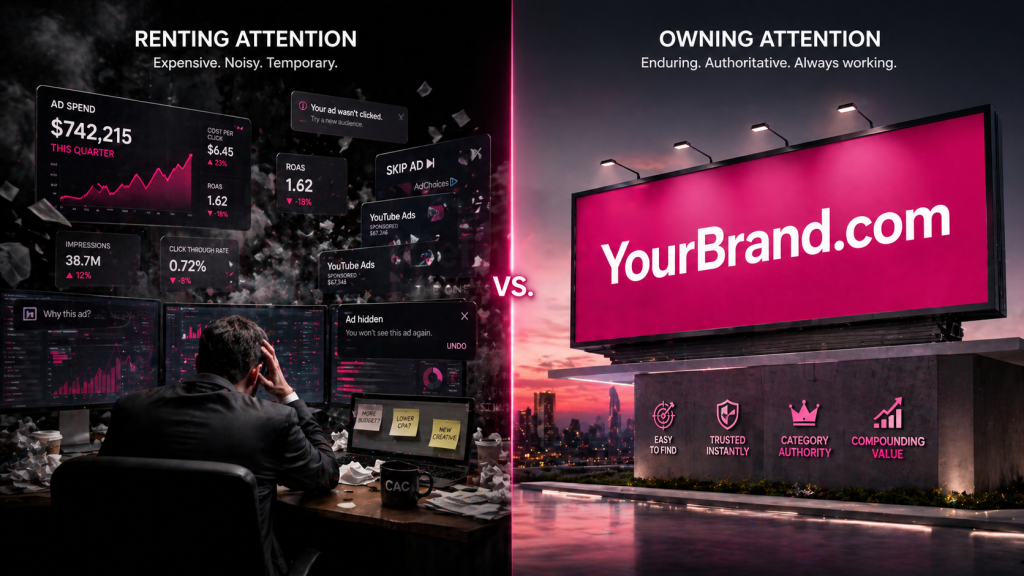
Owning the name vs. renting attention
Most CMOs frame the decision incorrectly. They think they’re choosing between spending on a domain or spending on marketing.
That’s not the trade-off.
A premium domain isn’t a replacement for marketing. It’s the foundation that makes marketing work better. It’s a multiplier for all of your existing efforts. Marketing builds awareness. A premium domain captures it.
When your domain is intuitive, people find you. When it’s authoritative, people trust you.
When it’s category-defining, you don’t have to explain why you belong.
No amount of marketing can fully compensate for friction at the point of discovery. And in a market where attention is scarce, friction is expensive.
Why “good enough” costs more
I’ve had this conversation dozens of times: a company weighs a $150K domain against two quarters of paid acquisition. The ads feel measurable. The domain feels static.
So they choose the ads. What they miss is what happens next.
Better domains improve click-through rates because users trust what they see.
They reduce CAC because branded search performs better.
They lower support costs because customers can find you without help.
They improve deliverability because your domain doesn’t trigger risk signals.
These are not theoretical gains. They show up across every channel.
And unlike ad spend, which disappears the moment you stop funding it, a domain compounds.
It appreciates as your brand grows.
It holds value if your strategy shifts.
It contributes to valuation if you exit.
The “cheap” option is often the most expensive one over time.
What investors see immediately
When I work with companies heading into Series B or C, one of the first things I assess is their domain.
Not because it’s cosmetic. Because it signals intent. A premium domain says you’re building for durability. A compromised domain suggests you’re preserving optionality.
Investors may not call it out explicitly, but they see it.
Category leaders own category-defining names. Everyone else works around them.
If you’re asking investors to believe you’ll dominate a space, your domain should reinforce that story. Not undermine it.
A permanent advantage most companies ignore
Most business investments depreciate.
Software expires.
Campaigns stop.
Talent moves on.
A premium domain does the opposite. It becomes more valuable on your balance sheet, AND is more defensible over time—and in the age of AI, many times is the only moat a company can own.
Competitors can copy your messaging. They can replicate your features. They can outspend you. They cannot take your domain.
That matters in crowded categories where differentiation is hard. The company with the clearest, most authoritative name starts with an advantage that compounds across every interaction.
Search.
Referrals.
Earned media.
Memory.
It’s not just digital real estate. It’s mental real estate.
Timing is where most companies get it wrong
The best time to secure the right domain is before launch. The second-best time is now.
What I see far too often is delay.
Companies build momentum around a compromised name. They invest in awareness. They convince themselves they’ll grow past the limitation.
They don’t. They just mask it.
And when they finally upgrade, the impact is immediate: Cleaner investor conversations. Higher conversion rates. Less friction everywhere.
The cost of waiting almost always exceeds the cost of acting.
How we approach it at Defining.com
We don’t treat domains as transactions. We treat them as strategic assets.
Every engagement starts with alignment. What are you building? Where do you want to lead? What does the market need to believe?
From there, we curate domain options that match both creative ambition and market reality. We pressure-test them against positioning, legal risk, and competitive context before anything moves forward.
Because once you commit to a name, you’re not just choosing a URL. You’re setting the ceiling for your brand.
What endures
Markets change. Products evolve. Strategies shift.
Your domain stays.
It’s one of the few assets that doesn’t depreciate, doesn’t expire, and doesn’t require constant reinvestment. And has a carrying cost of just dollars a year.
When you own the right domain, you’re not just buying a name. You’re securing an advantage that compounds across every channel, every interaction, every moment someone looks for you.
The premium domain isn’t the expensive choice. It’s the decision that makes everything else work better.